
Brazils Participatory Plurianual Plan: embedding citizen participation in federal strategic planning
A strategic planning process that led to the launch of the Brasil Participativo platform
Brasil Participativo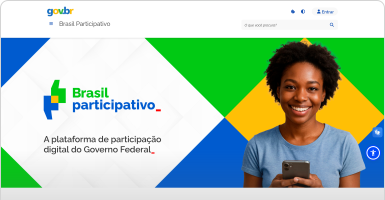
Type of process
Strategic Planning
Target public
Brazilian citizens, public representatives, civil society organisations (NGOs), social movements, social programs beneficiaries
Components used
- Proposals
- Pages
- Conferences
- Assemblies
- Blog
Results
Proposals submitted in the Plan Plurianual (2024-2027): 8,254 proposals
Proposals submitted
Total participants: 1,419,729 direct interactions, all validated through Brazil’s secure public digital identity system
Total participants
76% of proposals were incorporated into the Plan, 58% were fully integrated and 14% were partially integrated and 40 Government Ministries and Agencies were involved
Key points
The Plurianual Plan (PPA) is the Brazilian government's main planning instrument, provided for in the 1988 Constitution, which defines the Federal Government's guidelines, objectives and programmes for a four-year period. Historically, Brazil has been a benchmark for institutionalised social participation, with councils and conferences in key areas such as health, education, housing and human rights.
In January 2023, President Luiz Inácio Lula da Silva promoted the reactivation of social participation as a central axis of government action, committing to more democratic, inclusive and transparent public planning. In this context, the development of the PPA 2024-2027 was proposed as a process open to citizens, combining traditional participation mechanisms with digital tools with national reach.
To enable this large-scale participation, the Federal Government launched Brasil Participativo as a unified digital channel, allowing the participatory processes associated with the PPA to be concentrated in a single space. The platform was developed using the free software Decidim and hosted by Dataprev, with the support of the Ministry of Management and Innovation in Public Services through the ColaboraGov program. Since its creation, it has been managed by the National Secretariat for Social Participation, within the General Secretariat of the Presidency of Brazil, in partnership with the Laboratório de Competência em Software Livre (LabLivre) at the University of Brasília (UnB), which is responsible for its technical development and maintenance.
Participatory processes
The participatory process for the Plan Plurianual 2024-2027 was the most extensive and complex ever undertaken at the federal level in Brazil. Its objective was to effectively incorporate citizens' priorities into the definition of national public policies for the 2024-2027 period. Through digital and in-person mechanisms, citizens were able to submit proposals, debate them, vote on them and prioritise them, contributing directly to the final content of the Plan. In total, 8,254 citizen proposals were collected, of which 76% were incorporated in whole or in part. The PPA is structured around six national strategic priorities and 88 programmes that guide the Federal Government's action: I – Fighting hunger and reducing inequality II – Basic education III – Health: primary and specialised care IV – New Growth Acceleration Programme (New PAC) V – Neo-industrialisation, work, employment and income VI – Combating deforestation and responding to the climate emergency Citizen proposals were evaluated by technical teams, prioritised through public voting and finally integrated into the PPA programmes, ensuring traceability between social participation and government planning. The phases were structured into a process that activated different components and functionalities of Decidim in each case:
Development of the Strategic Framework ((March to April 2023))
The process began with defining the methodology and initially constructing a vision of the future, values, guidelines, strategic points and objectives based on internal workshops with a team of over 1400 public professionals.
1
Development of the Strategic Framework
((March to April 2023))
The process began with defining the methodology and initially constructing a vision of the future, values, guidelines, strategic points and objectives based on internal workshops with a team of over 1400 public professionals.
Proposal and prioritization ((April to July 2023))
This is the first participatory phase of the process using the Brasil Participativo platform.
Components:
-
Proposals: This component allowed the gathering of proposals by thousands of people across the country. Participants could submit and vote on proposals structured by thematic areas aligned with each ministry.
-
Blog: This component served as a communication and dissemination tool for sharing information about the current process and phases. The continuous update allowed to promote transparency and openness of the process.
2
Proposal and prioritization
((April to July 2023))
This is the first participatory phase of the process using the Brasil Participativo platform.
Components:
-
Proposals: This component allowed the gathering of proposals by thousands of people across the country. Participants could submit and vote on proposals structured by thematic areas aligned with each ministry.
-
Blog: This component served as a communication and dissemination tool for sharing information about the current process and phases. The continuous update allowed to promote transparency and openness of the process.
Prioritization
During the same period, participants could vote to prioritize 89 proposals presented by federal government ministries.
Components:
-
Proposals: Again, this component was used to collect votes according to participants preferences.
-
Blog: The follow-up process was communicated using the blog component and the prioritised proposals were exposed to participants.
3
Prioritization
During the same period, participants could vote to prioritize 89 proposals presented by federal government ministries.
Components:
-
Proposals: Again, this component was used to collect votes according to participants preferences.
-
Blog: The follow-up process was communicated using the blog component and the prioritised proposals were exposed to participants.
Submission and Validation by the Ministries ((August 2023))
The proposals prioritised by participants were consolidated into a report and sent for analysis by the ministries, who validated and incorporated the suggestions into the final plan.
4
Submission and Validation by the Ministries
((August 2023))
The proposals prioritised by participants were consolidated into a report and sent for analysis by the ministries, who validated and incorporated the suggestions into the final plan.
Submission, Legislative Review, and Approval by the National Congress ((August to December 2023))
The PPA bill was sent to the National Congress where it started a legislative process and was approved in December 2023.
5
Submission, Legislative Review, and Approval by the National Congress
((August to December 2023))
The PPA bill was sent to the National Congress where it started a legislative process and was approved in December 2023.
Enactment of the 2024–2027 Plurianual Plan (PPA) ((January 2024))
President Lula approved Law No. 14,802 , on January 10, 2024, which establishes the Multi-Year Plan 2024–2027.
6
Enactment of the 2024–2027 Plurianual Plan (PPA)
((January 2024))
President Lula approved Law No. 14,802 , on January 10, 2024, which establishes the Multi-Year Plan 2024–2027.
Revision of the PPA ((January to May 2025))
The contributions were analysed by the ministries and results were presented to the Inter-Council Forum on May 27, 2025. The feedback was also published on the Brazil Participativo platform.
7
Revision of the PPA
((January to May 2025))
The contributions were analysed by the ministries and results were presented to the Inter-Council Forum on May 27, 2025. The feedback was also published on the Brazil Participativo platform.
Monitoring and Open PPA ((January 2024 to December 2027))
The PPA is still being monitored and documented using the platform, so that anyone can follow up on the implementation of the programs. The Inter-Council Forum has also begun to monitor the plan.
8
Monitoring and Open PPA
((January 2024 to December 2027))
The PPA is still being monitored and documented using the platform, so that anyone can follow up on the implementation of the programs. The Inter-Council Forum has also begun to monitor the plan.
Worth mentioning that the two components exposed in phase 2 and 3 (proposals and blogs) were also used during the rest of the steps as the process is still active, especially during the councils monitoring phase.
A mobile-first platform
More than 161 million internet users
Brazil has more than 161 million internet users, most of whom access the internet primarily through mobile devices. This context led to the design of the PPA participatory process with a mobile-first approach, facilitating access from any location and reducing technical barriers to participation.
This approach was key to expanding the participation of people living in remote areas and groups historically underrepresented in public planning processes.
Innovation
- Integration of traditional in-person participation in councils, conferences, or social events with massive digital participation through the platform. This allows for combining the best of community activism with the possibilities of the digital environment.
- Open strategic planning: The PPA evolved from a predominantly technical instrument and consolidated itself as a policy process shared with citizens, setting a new benchmark for large-scale participation.
- The birth of Brasil Participativo, a platform that seeks to become the digital hub of participation at the federal level in Brazil, first of its kind using Brazil’s secure public digital identity system gov.br.
Impact
The process expanded and diversified the channels of participation while introducing large-scale digital engagement. This co-management process for the Plurianual Plan (PPA), which brought together government and civil society, began with the first meeting of the Inter-Council Forum on April 18–19 and extended across the country through state-level plenary sessions. These were supported by a broad digital mobilization effort carried out through the Brasil Participativo Platform.
One key achievement was that the process mobilized communities beyond the traditional participatory field. Evidence suggests that organized groups, including social movements, territorial networks, and professional communities such as community health workers, engaged collectively to submit and prioritize proposals.
Overall, this experience set a precedent for the rebuilding and consolidation of a renewed national participation strategy in Brazil, which had been dismantled under the previous administration. As the participatory process for the PPA unfolded and reached its conclusion, Brazil restored and strengthened its institutional framework for social participation, including:
- Reactivation of 60 councils and consultative bodies
- Establishment of the National Council for Social Participation
- Revival of the Inter-Council Forum
- Organization of more than 30 national conferences
- Creation of State Participation Forums in all federal states
- Implementation of an interministerial network of Social Participation Advisors across 35 ministries
Finally, the process enabled the modernization of Brazil’s digital participation infrastructure through the adoption of the Decidim free software platform. Over the past three years, the platform has consolidated more than 9 million visits and over 1.7 million participants, becoming the main digital channel for dialogue between government and civil society. Rather than a one-off consultation tool, the platform became a multi-process hub capable of hosting conferences, consultations, monitoring processes, and policy revisions, establishing the foundations of a digital public infrastructure for social participation in Brazil.
Lessons learned
While this process became the most participatory Multi-Year Plan in Brazil’s history, important structural challenges remain. Despite significant progress, the platform still faces barriers to achieving truly large-scale and representative participation across Brazilian society. Persistent inequalities in access to and use of digital technologies, connectivity limitations, and gaps in digital literacy continue to constrain broader inclusion.
For this reason, our current focus is on modernizing and optimizing the digital participation platform to advance inclusion, enhance representativeness, and enable large-scale engagement, while remaining firmly anchored in the principles of digital sovereignty. This includes, for instance:
- Exploring the responsible use of artificial intelligence to support citizens in drafting proposals and to assist public institutions in analyzing contributions, identifying priorities, and improving resource allocation.
- Launch of a Software-as-a-Service (SaaS) version tailored for subnational governments, enabling states and municipalities, that are closer to citizens’ everyday needs, to more easily deploy and manage their own digital participation platforms.
- The development of conversational participation flows based on the understanding lowering cognitive and procedural barriers is essential to engage citizens who are not accustomed to navigating institutional platforms. In a context where mobile messaging apps are the primary digital environment for millions of Brazilians, embedding participation within familiar conversational interfaces significantly reduces friction in onboarding, authentication, and proposal submission.
Testimonial
Partners

This use case has been written in collaboration with the Secretaria-Geral da Presidência da República, Cidade Democratica, University of Brasilia and LabLivre